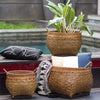
How Handwoven Baskets Help Reduce Environmental Impact
, by Theodora Martinou, 9 min reading time
, by Theodora Martinou, 9 min reading time
Discover how handwoven rattan, seagrass, and jute baskets replace plastic storage with renewable materials, low-impact craft, and lasting durability.
There is a particular kind of quiet that settles over a room once you've swapped something plastic for something woven. Maybe it's the laundry hamper that used to click and clatter with every load, now traded for something that creaks softly and smells faintly of dried grass. Maybe it's the planter cover on the balcony, or the tray that catches your keys by the door. Small swaps, but they add up to something larger than the sum of their parts — and that something is, quite simply, a lighter footprint on the planet we all share.
At Irregular Lines, we talk a lot about craftsmanship and story, but sustainability has always been sitting right beside those words, patient and unglamorous, waiting its turn. Handwoven baskets are one of the clearest examples we know of design that does right by both the home and the earth it exists in. They are humble objects — a laundry basket rarely gets the admiring glance a sculptural lamp does — yet in their material, their making, and their long working life, they quietly outperform almost everything mass-produced storage has to offer.
This is a closer look at how that happens: from the fibres in the field to the basket in your hallway, and everywhere in between.
At their simplest, handwoven baskets are storage and decorative pieces built by hand from natural fibres, rather than moulded from plastic or stitched together on an assembly line. Walk through the workshops of our partner artisans and you'll find the same handful of materials returning again and again: rattan, prized for its strength and flexibility; jute, coarse and honest; seagrass, pale and faintly sweet-smelling when freshly dried; bamboo, split into ribbons and coaxed into curves; and raffia, soft enough to fringe an edge or tie off a handle.
What ties these materials together is not just their origin in nature, but the way they're worked. Traditional weaving techniques — passed from one pair of hands to the next, often within the same family for generations — rely on very little beyond skill, patience, and a loom or frame that hasn't changed much in decades. There's no injection mould here, no plastic pellet melted down under heat. Just fibre, folded and looped and pulled taut until it holds its shape.

It's worth pausing on what handwoven baskets are quietly replacing, because the contrast is where their value becomes clear. Most conventional storage bins and décor pieces on the market today are built from plastic or other synthetic materials — cheap to produce at scale, and just as cheap to throw away.
That convenience comes at a cost the price tag never shows. Plastic storage is non-biodegradable, meaning a bin discarded today could still be sitting in a landfill centuries from now, essentially unchanged. Manufacturing it is energy-intensive, drawing on fossil fuels at nearly every stage. As it ages and abrades, it sheds microplastics — fragments so small they end up in waterways, soil, and eventually, research increasingly suggests, in us. And because it's designed to be inexpensive rather than enduring, it tends to crack, warp, or simply go out of fashion long before it's earned back the resources spent making it.
None of this is said to shame anyone for the storage bins already in their home — most of us have a few. It's simply the backdrop against which handwoven alternatives start to look less like a design choice and more like a meaningful one.
Rattan grows fast. So do bamboo, seagrass, jute, and raffia palm. These are plants that, left to their own devices, replenish themselves within a season or two — nothing like the decades a hardwood tree needs to mature, and worlds away from petroleum, which took millions of years to form and cannot be replaced within any human lifetime.
That renewability is the quiet engine behind everything else. Because the fibres regrow quickly, harvesting them doesn't strip a landscape the way heavier resource extraction can. Because they're biodegradable, a basket that finally reaches the end of its life doesn't linger — it breaks down and returns to the soil much as a fallen branch would. And because these materials generally require only minimal chemical processing — a soak, a dry, sometimes a light natural stain — the water and chemical burden of production stays low from field to finished piece. Organisations such as the Forest Stewardship Council exist precisely to help verify that renewable plant materials like these are harvested responsibly, so that what regrows quickly today isn't quietly depleted tomorrow.
Even at the very end of a basket's life, this matters. A cracked plastic bin is a cracked plastic bin forever. A worn-out rattan basket, tucked into a garden bed or a compost pile, simply becomes part of the ground again.
Ask an artisan how a basket is made and they won't describe a production line. They'll describe hands — their own, and often their mother's or grandfather's before them. Handweaving is, almost by definition, manual work. There is no factory floor humming with heavy machinery, no assembly line stamping out identical shapes hour after hour.
That manual approach carries real environmental weight. Energy consumption stays low because the "machinery" is mostly a person, a blade, and sometimes water for softening fibres. There's no large-scale industrial equipment drawing power around the clock, which means the carbon emissions tied to producing a single basket are a fraction of what a plastic equivalent would generate. And because each piece is shaped deliberately, fibre by fibre, waste during production is limited — offcuts get repurposed into smaller pieces or ties, rather than swept into a bin.
It's slower, certainly. A skilled weaver might spend the better part of a day on a single large basket. But slowness, here, is doing quiet environmental work that speed never could.
Good weaving is deceptively strong. The same over-under structure that makes a basket flexible enough to be shaped by hand also makes it remarkably resistant to the everyday knocks of a real home — being dragged across a floor, stacked with towels, nudged gently out of the way by a toddler.
Part of what makes handwoven pieces last is that they're also repairable. A loose strand can be tucked back in. A worn handle can be re-bound. This kind of care simply isn't possible with an injection-moulded bin — once plastic cracks, it's finished, and into the bin, ironically, it goes. A basket, by contrast, can be mended by hand, much as it was made.
All of this adds up to a much longer working life, which means fewer replacements purchased, fewer resources consumed over time, and less waste generated per year of actual use. And because baskets are so adaptable — equally at home holding towels, toys, plants, or throws — one well-made piece can move through several roles in a household over the years, rather than being discarded the moment its original purpose changes.
This is where theory becomes practical. A handwoven basket can step into nearly every role a plastic container currently fills, usually with more warmth and considerably more longevity. In the laundry room, a basket like our Keke Round Basket does the job of any laundry bin, minus the hollow plastic clatter, and looks just as at home in a bedroom corner holding cushions or throws.
In the garden or on a windowsill, seagrass and rattan baskets make wonderful planters and pot covers — swap out the bare plastic nursery pot the moment a plant comes home, and slip it into something like our Paxoi Basket with Handle instead. On shelving, baskets bring order to loose odds and ends — remotes, chargers, spare linens — while adding texture that a stack of plastic bins simply can't. And as purely decorative accent pieces, a basket like our Tanngo Basket can anchor a console table or sit beside a doorway, doing nothing more strenuous than looking beautiful.
The common thread is this: almost anywhere plastic storage has quietly taken over a home, a handwoven basket can take its place — and tends to outlast it besides.

It would be incomplete to talk about the environmental story of handwoven baskets without talking about the people behind them. Nearly every basket in this category — including the ones we carry — is made by artisan communities, many working within traditions of weaving that stretch back generations.
Choosing handwoven pieces supports that traditional craftsmanship directly, rather than routing value through a distant factory. Done well, it also means fair labour opportunities for skilled makers whose work is genuinely difficult to automate — no machine yet folds rattan the way a practised hand does, in the spirit championed by organisations like the World Fair Trade Organization, which has spent decades advocating for fair wages and dignified working conditions among artisan producers worldwide. And it helps preserve cultural skills that might otherwise fade as households default to whatever's cheapest and fastest online.
In other words, the sustainability of a handwoven basket isn't only measured in carbon and biodegradability. It's measured in livelihoods, too.

Add it all up — renewable materials, low-energy production, genuine durability, and the people whose hands make it all possible — and a handwoven basket starts to look like one of the more quietly radical choices you can make for a home. It replaces plastic without replacing warmth. It reduces waste without reducing beauty. And it does so one laundry basket, one planter, one shelf at a time.
If you've been meaning to make that swap, we'd love to help. Explore our collection of handwoven baskets and natural fibre storage at Irregular Lines, or get in touch with us directly — we're always happy to help you find the right piece, and the right story, for your space.
Subscribe to our emails